
New Year’s Resolutions Don’t Work with hEDS…
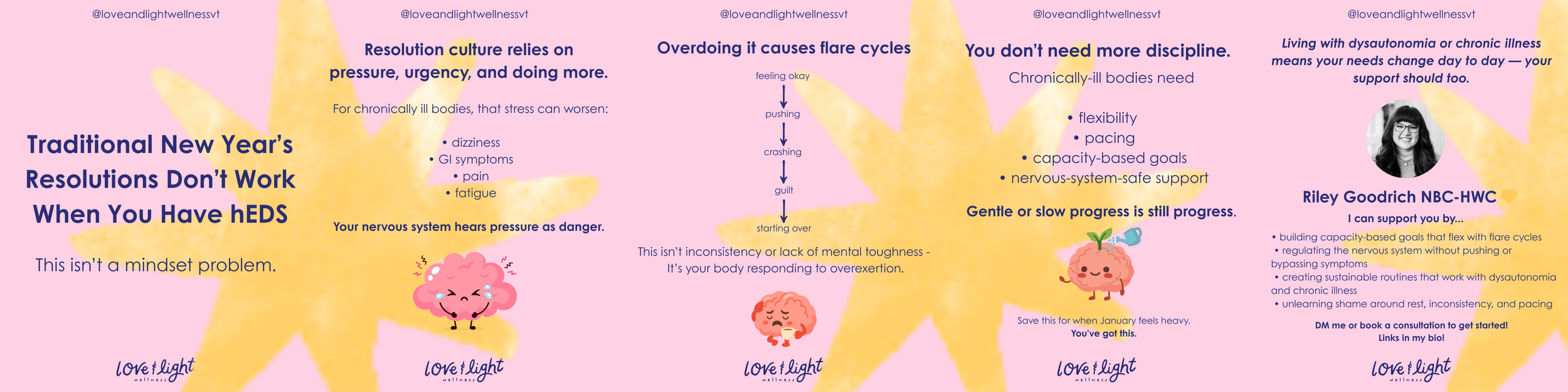
Every January, we’re flooded with the same message: this is the year you finally become disciplined enough. Strong enough. Consistent enough. And if you live with hypermobile Ehlers-Danlos Syndrome (hEDS), that message can quietly (or loudly) turn into shame by February. Because no matter how much you want to follow through, your body doesn’t cooperate in the way productivity culture promises it should.
This isn’t a personal failure. It’s a mismatch between your body and a model that was never built for it.
The Problem with New Year’s Resolutions
Most New Year’s resolutions are rooted in a few unspoken assumptions:
Bodies are predictable and linear
Consistency means doing the same thing every day
Effort reliably leads to results
Rest is something you earn after productivity
For many people with hEDS, none of these assumptions hold true.
hEDS often comes with chronic pain, joint instability, fatigue, autonomic dysfunction, gastrointestinal symptoms, and fluctuating energy levels. These symptoms don’t follow a neat upward trajectory. They ebb and flow. They respond to stress, sleep, weather, hormones, illness, and nervous system load.
A rigid goal — exercise five days a week, wake up at 6am, cook every meal, never cancel plans — doesn’t account for flares, subluxations, or days when simply standing upright is a win.
When the body inevitably says no, the story becomes: I failed.
But the truth is: the resolution failed you.
hEDS Is a Nervous System Condition, Too
While hEDS is often discussed in terms of joints and connective tissue, many of its most disruptive symptoms are driven by nervous system dysregulation. Pain, POTS symptoms, nausea, dizziness, temperature intolerance, and fatigue are not issues you can override with discipline. They are signals from a nervous system that is working very hard to keep you safe. When resolutions rely on pushing through discomfort, they often increase sympathetic activation (stress response), which can worsen symptoms rather than improve them.
In other words: trying harder can make things harder.
Why “Consistency” Needs a Redefinition
In mainstream culture, consistency is framed as sameness. For hEDS bodies, consistency looks more like responsiveness.
It might mean:
Doing your physical therapy exercises three times one week and none the next
Walking one day and choosing rest the next
Showing up to a practice differently each time
This isn’t inconsistency. It’s adaptive intelligence.
Your body is constantly negotiating safety, stability, and energy. Listening to those signals is not a lack of commitment — it is the commitment.
From Resolutions to Regulation
Instead of New Year’s resolutions, many people with hEDS benefit from shifting toward regulation-based intentions.
Rather than asking:
How can I do more this year?
Try asking:
What helps my joints feel supported?
What stabilizes my energy?
What signals tell me I’m approaching overload?
What forms of movement feel regulating instead of depleting?
These questions invite collaboration with your body instead of control over it.
Building Goals That Bend
Goals don’t have to disappear entirely — they just need to bend.
Some examples:
Instead of: “Exercise 5 days a week”
Try: “Engage in joint-supportive movement when my body has capacity”Instead of: “Never cancel plans”
Try: “Practice honest check-ins with my energy and pain levels”Instead of: “Be more disciplined”
Try: “Notice what systems make care easier to access”
When goals are flexible, they stop becoming tools of self-judgment and start becoming tools of self-support.
You Don’t Need a New Year — You Need a Kinder System
If New Year’s resolutions haven’t worked for you, that doesn’t mean you’re broken. It means your body requires pacing, accommodation, and nervous system safety — not hustle culture disguised as self-improvement. Progress with hEDS is rarely loud or linear. It’s subtle. It’s relational. It’s built through listening rather than forcing.
You don’t need to become more disciplined: you need systems — internal and external — that respect the reality of your body. That is not giving up.
That is wisdom.
Curious about what a change of perspective might look like for you? Happy to help - let’s do this.