
If You Can’t Connect the Issues, Think Connective Tissues
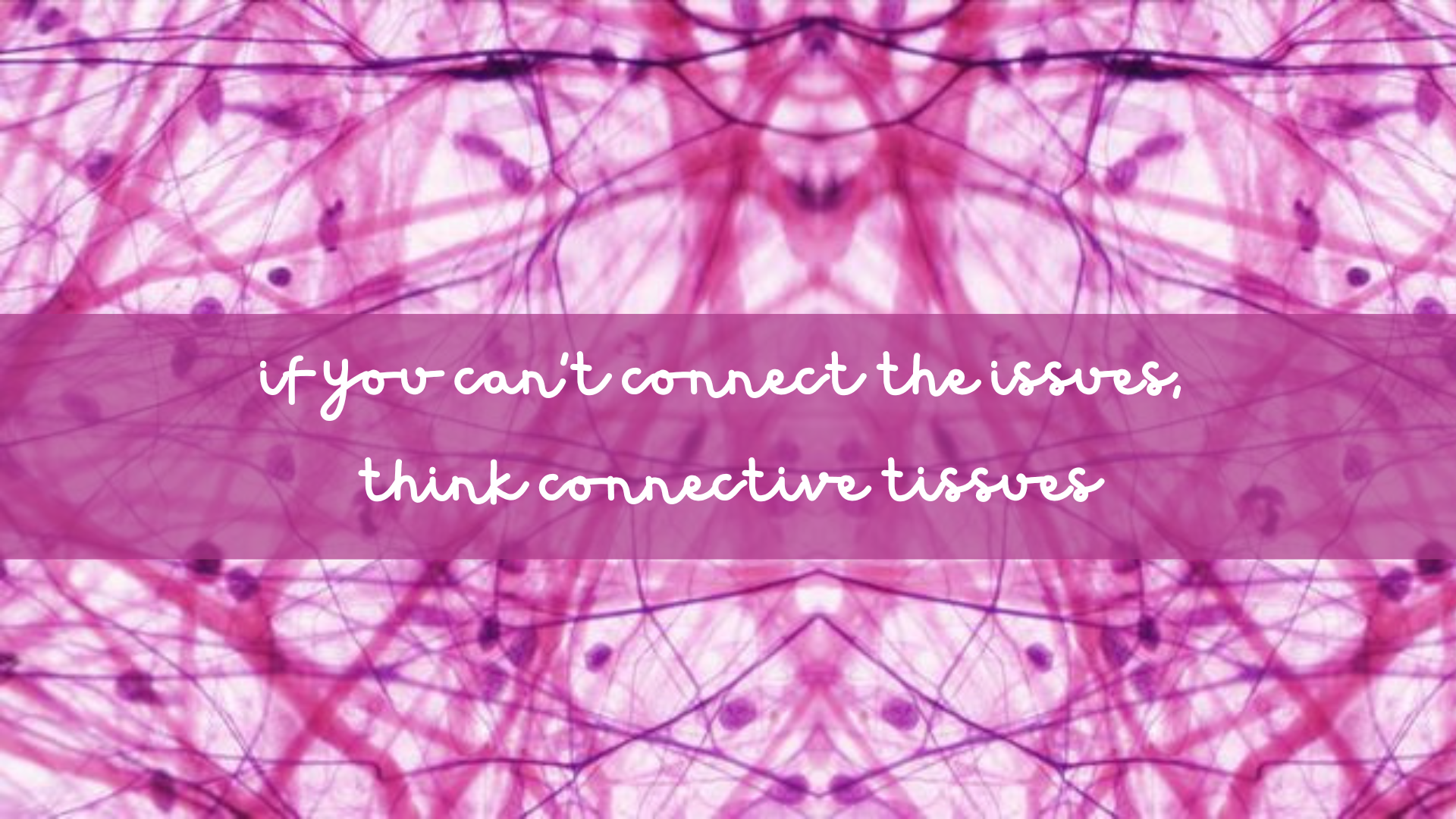
There’s a saying in the Ehlers-Danlos community: “If you can’t connect the issues, think connective tissues.”
It’s clever, but it’s also true. Ehlers-Danlos Syndrome (EDS) isn’t just a “joint problem.” It’s a connective tissue disorder — and connective tissue is everywhere in the body. It holds us together, literally. It provides structure, elasticity, and support for our skin, joints, blood vessels, organs, and more.
So when connective tissue doesn’t function the way it’s supposed to, the effects can ripple across every system.
Why It Affects So Much
Connective tissue is like the body’s glue and scaffolding combined. In EDS, that glue is weaker or stretchier than it should be — and that can lead to a wide range of symptoms that may not seem related at first glance.
You might notice:
Joint instability and pain – because the ligaments and tendons are too loose to hold joints in place.
Digestive issues – because the GI tract depends on connective tissue for structure and motility.
Easy bruising and fragile skin – because blood vessel and skin tissue lack integrity.
Autonomic nervous system dysfunction – such as POTS (Postural Orthostatic Tachycardia Syndrome), where blood vessels struggle to constrict properly, leading to dizziness and heart rate spikes.
Immune and allergic-type responses – like Mast Cell Activation Syndrome (MCAS), which can make the body overly reactive to foods, scents, and environmental triggers.
When you zoom out, you start to see how it all connects: one root cause, many branches.
The “Invisible” Complexity
For many people with EDS, the biggest challenge isn’t just managing the symptoms — it’s being believed. Because EDS affects multiple systems, it can look like “a little bit of everything”: fatigue, pain, GI distress, anxiety, temperature intolerance, skin issues, and more. Without awareness, patients often get referred to multiple specialists who each see one piece of the puzzle — but not the whole picture.
That’s why the phrase “if you can’t connect the issues, think connective tissues” is such a powerful reminder. It asks clinicians and patients alike to step back and consider the systemic nature of the body, not just its separate parts.
A Web, Not a List
Living with EDS (and its common comorbidities like POTS, MCAS, chronic fatigue, and dysautonomia) means learning that everything in the body is interconnected. What affects one area can cascade into others — and healing often means tending to the whole system, not just one symptom.
It’s also a reminder to approach care with compassion and curiosity. If something doesn’t add up, maybe it’s not that someone is “overreacting” or “making it up.” Maybe it’s that we haven’t connected the issues yet.
In the End
Ehlers-Danlos teaches us that the body is a web, not a collection of separate strings. When that web is woven differently, it changes how everything feels and functions — but it also deepens our understanding of just how connected we truly are.
So the next time someone says, “That’s strange, how could all those things be related?”
You can smile and say:
“If you can’t connect the issues… think connective tissues.”
Curious about how this might apply to your body? I can help you navigate your web.